CS352: Computer Science Pedagogy - Bloom's Taxonomy
Activity Goals
The goals of this activity are:- To explain the hierarchical nature of Bloom's Taxonomy
- To design lessons that engage students at multiple levels of Bloom's hierarchy
Supplemental Reading
Feel free to visit these resources for supplemental background reading material.The Activity
Directions
Consider the activity models and answer the questions provided. First reflect on these questions on your own briefly, before discussing and comparing your thoughts with your group. Appoint one member of your group to discuss your findings with the class, and the rest of the group should help that member prepare their response. Answer each question individually from the activity, and compare with your group to prepare for our whole-class discussion. After class, think about the questions in the reflective prompt and respond to those individually in your notebook. Report out on areas of disagreement or items for which you and your group identified alternative approaches. Write down and report out questions you encountered along the way for group discussion.Guiding Questions
- Why might learning goals that say students will "understand" be less effective than other verbs? What are good alternatives, and why?
- Is it a good goal to aim at the top of Bloom's Taxonomy all the time, or vary assessment between all layers?
- Complete the verb sort and goal-writing activity at the bottom of this page with your group, and prepare to defend your placements.
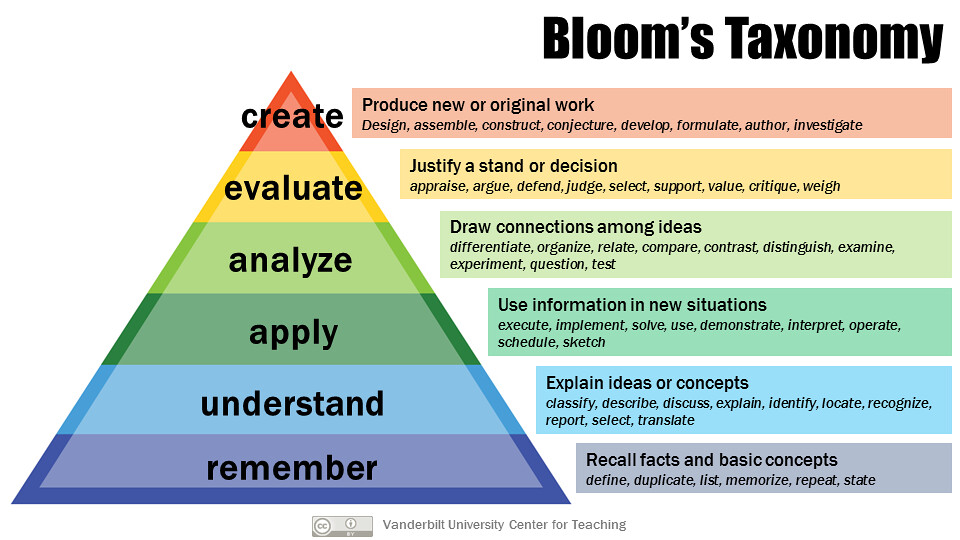
Model 1: Bloom's Taxonomy
Questions
- Consider a lesson on Bloom's Taxonomy. What are examples of questions at each layer that would demonstrate competence with the framework?
- Consider a unit on binary number encoding. What would be a good example of an assessment question or activity that exemplifies each layer of Bloom's Taxonomy?
- Is it better to focus only on one layer of Bloom? Why or why not?
Bloom’s Taxonomy in Computer Science Education
Bloom’s Taxonomy is a hierarchical model used to classify educational learning objectives into levels of complexity and specificity. It consists of six levels, each representing a different type of cognitive skill. Here’s how each level can be connected to computer science education, with examples and benefits of varying these levels in authentic assessment.
1. Remembering
Definition
- The ability to recall or recognize specific facts and basic concepts.
Example in Computer Science
- Memorizing the syntax of a programming language like Python or Java.
Authentic Assessment Benefit
- Ensures that students have a foundational understanding of essential concepts.
2. Understanding
Definition
- The ability to explain ideas or concepts.
Example in Computer Science
- Explaining how a sorting algorithm like Quick Sort works.
Authentic Assessment Benefit
- Helps in assessing whether students can interpret and paraphrase complex concepts.
3. Applying
Definition
- The ability to use information in new situations.
Example in Computer Science
- Implementing a data structure like a linked list in a new programming project.
Authentic Assessment Benefit
- Encourages problem-solving and the practical application of theoretical knowledge.
4. Analyzing
Definition
- The ability to draw connections among ideas.
Example in Computer Science
- Analyzing the time and space complexity of different algorithms.
Authentic Assessment Benefit
- Promotes critical thinking and the ability to dissect complex problems.
5. Evaluating
Definition
- The ability to justify a decision or course of action.
Example in Computer Science
- Evaluating the best algorithm to use for a specific task.
Authentic Assessment Benefit
- Encourages students to make informed decisions and defend their choices.
6. Creating
Definition
- The ability to produce new or original work.
Example in Computer Science
- Designing a new software system or developing a novel algorithm.
Authentic Assessment Benefit
- Fosters creativity and innovation, allowing students to synthesize knowledge in unique ways.
Example Verbs to Assess Each Level of Bloom’s Taxonomy
| Remember | Understand | Apply | Analyze | Evaluate | Create |
|---|---|---|---|---|---|
| Define | Explain | Implement | Compare | Assess | Design |
| List | Describe | Use | Contrast | Critique | Build |
| Name | Interpret | Demonstrate | Distinguish | Judge | Construct |
| Recall | Summarize | Perform | Examine | Justify | Produce |
| Recognize | Paraphrase | Solve | Investigate | Argue | Invent |
| Repeat | Classify | Execute | Differentiate | Appraise | Formulate |
| State | Compare | Construct | Break down | Evaluate | Compose |
| Validate | Synthesize |
Benefits of Varying the Level of Bloom’s Taxonomy in Authentic Assessment
- Diverse Skill Development: By varying the levels, educators can target different cognitive skills, from basic recall to creative synthesis.
- Holistic Understanding: It ensures that students not only memorize facts but also understand, apply, analyze, evaluate, and create based on the learned material.
- Customized Learning Paths: Allows for differentiation in instruction and assessment, catering to diverse learning needs and styles.
- Enhanced Engagement: Engages students at different cognitive levels, keeping learning stimulating and challenging.
- Preparation for Real-World Challenges: Mimics the multifaceted nature of real-world problems, preparing students for complex tasks in their future careers.
Activity: From Verbs to Goals
Learning goals live or die by their verbs: the verb determines what evidence of learning you can collect, and therefore what you can assess. In this activity, you will first sort verbs into the levels of Bloom’s Taxonomy, and then use those categorized verbs to author lesson goals at each level. (Transparency note, in the TILT spirit: the purpose is to make you fluent in choosing assessable verbs; the task is the sort and goal-writing below; the criteria are that each goal names an observable behavior, and that your group can defend each verb’s placement.)
Part 1: Sort the Verbs
Working in groups of 3-4 (this makes a great think-pair-share or POGIL-style exercise), sort the following verbs into the six levels of Bloom’s Taxonomy. Do not peek at the table earlier on this page until your group has committed to placements! Some verbs are genuinely arguable - that is the point. For any verb your group debated, record why: often the level depends on the context of the task rather than the verb alone.
trace • debug • define • refactor • predict • implement • justify • list • compare • design • summarize • test • identify • critique • modify • explain • compose • classify
Then discuss:
- Which verbs did your group place instantly, and which caused debate?
- Pick one debated verb (for example, debug). Write two classroom tasks using that verb that sit at different Bloom levels. What features of the task, not the verb, set the level?
- Which verbs would be nearly impossible to assess? (Hint: where would you place “understand” or “appreciate” - and what does that tell you about using them in goals?)
Part 2: From Verbs to Goals (Worked Example First)
Now use your sorted verbs to author lesson goals. Here is a worked example for a middle-school lesson on binary number encoding, with one goal per level:
| Bloom Level | Verb | Lesson Goal |
|---|---|---|
| Remember | List | Students will be able to list the place values of the first eight binary digits. |
| Understand | Explain | Students will be able to explain why 8 bits can represent exactly 256 distinct values. |
| Apply | Convert (implement) | Students will be able to convert any decimal number from 0-255 into binary. |
| Analyze | Compare | Students will be able to compare binary and decimal representations to determine which quantities cause carrying in each. |
| Evaluate | Justify | Students will be able to justify a choice of number of bits for a given application (e.g., storing ages vs. world population). |
| Create | Design | Students will be able to design their own encoding scheme for a non-numeric domain (e.g., colors or emojis) and document its capacity. |
Notice three properties of each goal, which form your quality criteria:
- It begins “Students will be able to…” followed by an observable verb - you could watch or read something and check it.
- The verb’s Bloom level matches the cognitive work actually demanded, not just the word chosen.
- The goal implies its own assessment: each row tells you what evidence to collect.
Your turn: choose a CS topic your group knows well (loops, variables, the internet, sorting, events in Scratch…) - or better, the topic of your upcoming lightning talk or UbD lesson plan. Using verbs from your Part 1 sort, write one goal at each of the six levels, in the same table format. Then trade tables with another group and audit each other’s work: for each goal, (a) is the verb observable, and (b) does the task truly sit at the claimed level, or has a “create-sounding” verb been attached to a “remember-level” task?
Wrap-Up Discussion
- Which levels were hardest to write goals for, and why?
- A complete unit rarely needs six goals per lesson. Which levels would you target in the first lesson of your unit, and which in the last? How does this connect to backwards design (UbD)?
- Keep your verb sort: it becomes a reusable planning tool when you write the goals for your UbD Lesson Plan and unit design labs.